If you live in Iowa, you’ve probably noticed that water quality keeps coming up in conversation—at the dinner table, in the news, and at the polls. A recent survey found that 58% of Iowa voters now rank water quality as a ‘very serious’ issue. Rising cancer rates are a major concern on voters’ minds, outpacing even cost of living.
These numbers are concerning, especially if you and your family have planted roots in Iowa. We put together this guide, not to add to the worry, but to give you a clearer picture of what’s happening with water quality in our area and what you can do about it in your own home.
Iowa’s Water Quality Challenges, in a Nutshell

Iowa’s biggest water quality challenge is what’s getting into our waterways before water ever reaches a treatment plant. The main culprit is nutrient runoff, specifically nitrates, from agricultural land.
A group of researchers from across the state published the Central Iowa Source Water Research Assessment Report in 2025. Their findings put some hard numbers on what Iowans already suspected: roughly 80% of the nitrogen entering the Des Moines and Raccoon River watersheds comes from agricultural sources.
Other highlights from the report:
- 40% of nitrogen comes from fertilizers applied directly to cropland
- 20% is from soybeans and legumes that pull nitrogen from the atmosphere and convert it to nitrate
- 20% comes from manure
When nitrate levels climb too high in source water, treatment plants have to work harder to bring them back down. In June 2025, nitrate levels in the Raccoon River hit nearly 18.5 milligrams per liter—well above the EPA’s 10 mg/L limit for drinking water. The Des Moines River wasn’t far behind at just over 17 mg/L.
“The fact that we’re still seeing the levels that we are tells us that the land has plenty of nitrogen to give, and unfortunately, we’re seeing how water systems are having to struggle to manage that,” said David Cwiertny, director of the Center for Health Effects of Environmental Contamination at the University of Iowa, in an interview with Iowa Public Radio.

The Cedar and Iowa Rivers—the drinking water sources for Cedar Rapids and Iowa City—face the same agricultural contaminants. A USGS study of Eastern Iowa’s river basins found that nitrate exceeded the EPA’s drinking water standard in 22% of stream samples, with the worst numbers showing up in areas with the most intensive row-crop farming.
Data from Iowa Water Quality Information System sensors on the Iowa River in Iowa City showed elevated nitrate levels through the fall of 2025, surpassing levels observed in previously monitored years.
Municipal water treatment facilities in Iowa do an impressive job of treating water before it reaches your faucet. But the source water challenges are ongoing, and emerging research suggests that long-term exposure to elevated nitrate levels, even below the federal limit, may pose health risks, including links to certain cancers.
Closer to Home: Lead in Iowa City Drinking Water
Iowa City has approximately 2,900 parcels with known or suspected lead service lines. A service line is the underground pipe that connects your home to the water main.
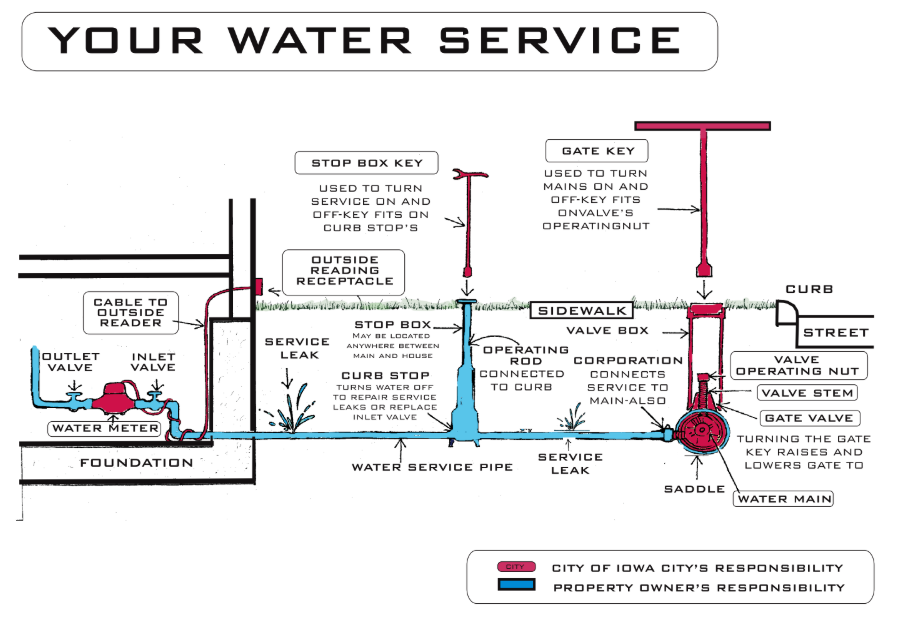
If your home was built before 1988, there’s a chance your pipe is made of lead, contains lead-contaminated galvanized iron, or has copper pipes joined with leaded solder.
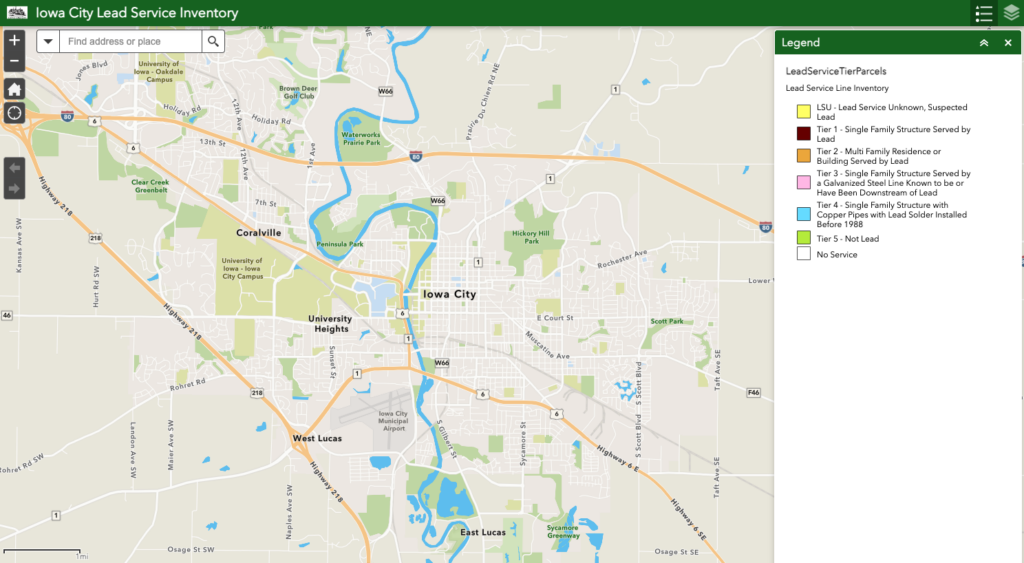
The City of Iowa City assigns each property a tier based on its lead risk:
- Tier 1: Single-family home with a confirmed lead service line
- Tier 2: Multi-family buildings with a confirmed lead service line
- Tier 3: Single-family home with a lead-contaminated galvanized iron line
- Tier 4: Single-family home with copper pipes joined by a leaded solder (generally homes built between 1950 and 1988)
- LSU (Lead Service Unknown): Homes built before 1950 without enough records to confirm the line material
Having a lead pipe doesn’t always mean your drinking water contains lead. Iowa City adds a corrosion inhibitor to the water supply that deposits a thin calcium carbonate layer on the inside of pipes. This creates a barrier between the water and the pipe, and the protective layer performs well under normal conditions.
But repairs, construction, or a water main break can strip that layer away. It takes about six months for the barrier to re-establish itself.
The people most vulnerable to lead exposure are infants, young children, and pregnant women. Lead can build up in the body over time and affect brain development, red blood cells, and the kidneys. Even though Iowa City’s water system is well-managed, it’s still important to know what’s in your pipes.
How to Know If You Have Lead Pipes

The age of your home is the single biggest clue. Iowa banned lead solder in 1988, and federal regulators tightened the definition of ‘lead free’ for fixtures again in 2014. That means the older your home, the more likely it is to have lead somewhere in the plumbing system, whether that’s the service line itself, the solder connecting copper pipes, or the faucets and fixtures.
Other Ways to Assess Your Risk
Check the Iowa City Lead Service Inventory Map
Available at icgov.org/water, this map shows Iowa City homeowners their property’s assigned tier and risk level. The city created this list using water main tap records, building permits, assessor data, service repair records, and conversations with local plumbers and tradespeople.
Look for a Notification Letter
Iowa City is required to send annual letters to homeowners with known or suspected lead service lines. If you received a letter, you don’t have to take immediate action, but it’s good to explore your options.
Get Your Water Tested
The City offers free lead testing through the Water Division, and the University of Iowa’s Get the Lead Out program provides at-home sampling kits. If you test your water, keep in mind that a clean test only confirms corrosion control is working at that moment, but it doesn’t prove there are no lead components in your plumbing.
Request a Verification Dig
If the inventory map lists your home as LSU (Lead Service Unknown), Iowa City’s cost-share program will reimburse 50% of the cost (up to $3,000) to excavate and verify what your service line is made of.
What You Can Do About Lead Pipes
Once you know about your home’s pipes, Iowa City has a solid set of programs to help you take action.
First, look into Iowa City’s Lead Reduction Program. The city offers cost-share reimbursements across three categories:
- Lead service line replacement: 50% of the cost, up to $5,000. Contact a local excavating or plumbing contractor for a quote, and let them know you want to use the city’s reimbursement program.
- Verification dig: For homes listed as LSU, the city will reimburse 50% up to $3,000. If the dig confirms lead, you can stack this with the replacement cost-share, so you could receive up to $8,000 in assistance.
- Faucets, filters, and fountains: 50% up to $500 for replacing a pre-2014 faucet, or 50% up to $1,000 for a point-of-use filtration system (including reverse osmosis) for homes built before 1988.
The city funds this program on a fiscal year cycle (July through June), so availability can change. Income-qualified residents may also qualify for additional assistance through the city’s Housing Rehab Program.
And if you’re not ready for a full replacement, the city recommends looking into service line insurance. A surprise line break can cost thousands, or even tens of thousands, if your line runs under a driveway or sidewalk. Your homeowners insurance might cover it, or you can check with Service Line Warranties of America, which partners with the Iowa League of Cities.
Steps You Can Take to Improve Your Drinking Water

Whether you have lead concerns or you just want to be proactive about water quality, there are things you can do today.
Flush Your Tap When Water’s Been Sitting
If the water in your pipes has been stagnant for six or more hours—overnight or while you’re at work, for example—run the cold tap for 15 to 30 seconds before using it. This clears the water that’s been sitting in contact with your plumbing and pulls fresh water from the main.
Always Drink and Cook with Cold Water
Hot water dissolves lead faster than cold water. If you need hot water for cooking, draw it cold and heat it on the stove or in the microwave.
Note: Boiling water does not remove lead; it concentrates it as the water evaporates.
Clean Your Faucet Aerators
That little screen at the tip of your faucet can trap sediment, debris, and lead particles over time. Clean it regularly—it only takes 30 seconds.
Be Cautious with Home Water Softeners
Iowa City softens its water before distribution. If you’re running an additional softener at home, it can change the water chemistry enough to make it more corrosive, increasing lead leaching from older pipes and fixtures.
Check Your Electrical Grounding
Many older homes have their main electrical ground connected to the water pipes. This can speed up corrosion. A licensed electrician can determine whether you can relocate the ground (don’t try this one on your own!).
Consider a Water Treatment System
A reverse osmosis (RO) system installed under your kitchen sink is one of the most effective options for removing lead and nitrates from your drinking water. Look for systems certified to NSF/ANSI 58.
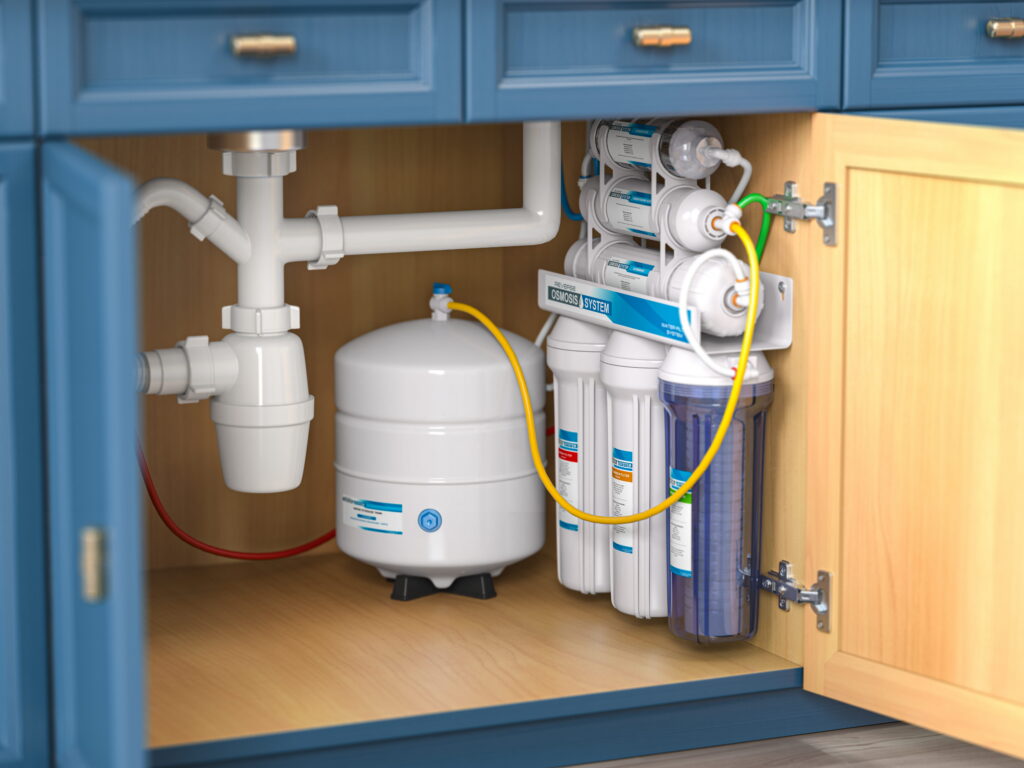
Point-of-use filters (like those that mount to your faucet) certified to NSF/ANSI 53 are effective for lead reduction, but they won’t remove nitrates. Pitcher-style filters vary, so check the certification before assuming they’ll do the job.
And don’t forget about the city’s cost-share program that can cover up to $1,000 toward a filtration system. Whatever system you choose, keep up with filter replacements and manufacturer-recommended maintenance. A neglected filter can contribute contaminants rather than remove them.
What This Means If You’re Buying or Selling a Home
Under the federal Lead and Copper Rule Improvements, utilities must now notify homeowners yearly about their service line status. This information is becoming more accessible and more relevant during your home purchase.
If you’re buying an older home, ask about the service line material. Check the property’s tier on the Iowa City Lead Service Inventory Map. It will give you a clearer picture of what you’re working with.
If you’re selling, being proactive is also important. Having documentation of a line replacement, a clean water test, or a recently installed filtration system gives buyers confidence. Plus, it shows your home has been well cared for.
Our agents are happy to help you think through these questions during a home search. We’re not here to talk you out of the home you love—we want you to have the information to feel confident in your decision.
Where to Go from Here

While Iowa’s agricultural and aging infrastructure landscapes present unique water challenges, they don’t have to control your daily life. Local programs in Iowa City can offset the cost of modernizing your home’s water system, making upgrades more manageable and affordable.
If you want to dig deeper, here are some places to start:
- Iowa City Lead Service Inventory Map: icgov.org/water
- Iowa City Water Division: 319-356-5160
- Get the Lead Out Iowa (free testing): gettheleadout.uiowa.edu
- Service Line Warranties of America: slwofa.com
- Iowa City Housing Rehab Program: 319-356-5129
- Iowa DNR Drinking Water Resources: iowadnr.gov
For Those Outside of Iowa City
Much of this post focuses on Iowa City because the city has the most extensive lead infrastructure challenges in Johnson County—roughly 11% of all service lines. But if you live elsewhere in Johnson County, this information is still applicable.
Fortunately, lead service lines are far less common in neighboring communities. North Liberty investigated 961 potentially affected service lines and confirmed that none contained lead. Coralville has narrowed its inventory down to about 83 lines that could have lead contamination (roughly 1% of its 6,300-plus service lines). Most of Coralville’s water system is newer or has been redeveloped over the years.

Photo Credit: Iowa Geological Survey
It’s also worth noting that the communities in this area draw from different water sources. Iowa City uses alluvial wells near the Iowa River, while Coralville, North Liberty, Tiffin, and Solon primarily rely on the Silurian aquifer. The statewide nitrate challenges affect all of these sources, though the specifics vary.
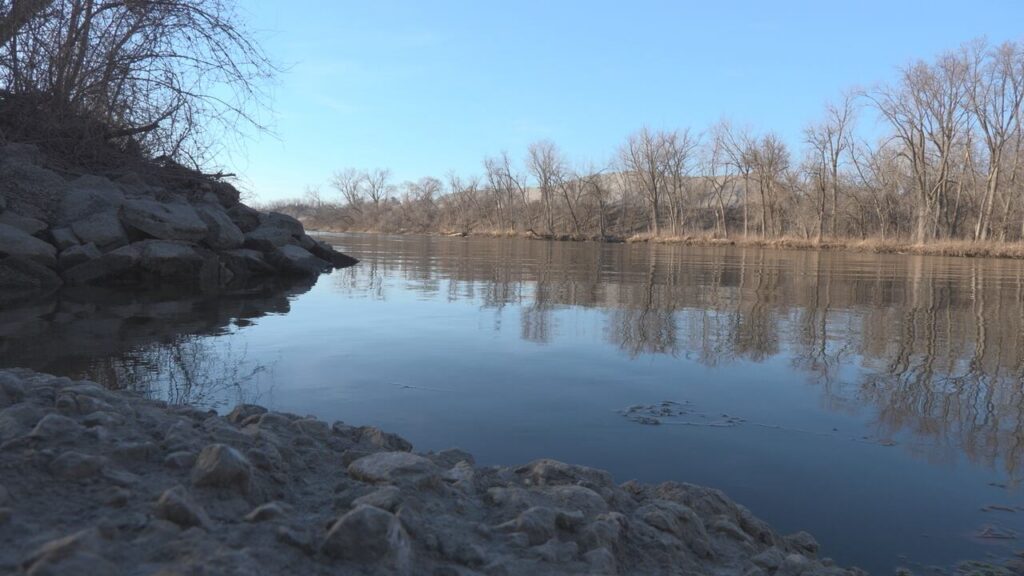
Photo Credit: Brian Tabick (KCRG)
Every water system in Iowa was required to submit a lead service line inventory to the Iowa DNR by late 2024, so your community should have information available about what’s in the ground.
If you’re not sure where to start, contact your local water utility directly. You can also request a water test through the State Hygienic Lab (1-800-421-IOWA) or sign up for a free test through the Get the Lead Out Iowa program.
Whether you’re in a 1920s bungalow in Longfellow or a newer build in North Liberty, the water coming out of your tap is worth paying attention to. And if water quality comes up during your home search, we’re always here to talk it through with you!