The appraiser has come and gone, and now you’re checking your inbox every five minutes. For buyers in the Iowa City-Cedar Rapids Corridor, this waiting period brings up two questions: what happens after a home appraisal, and how long after the appraisal is closing?
Most of the time, it’s just a week or two of paperwork standing between you and your new home. But sometimes an appraisal hits a minor bump in the road and the value comes in below what you offered.
If you’re still waiting on the appraisal, start with our guide, When is the Appraisal Done When Buying a Home.
If the report is already on its way, keep reading!
What Happens After a Home Appraisal?
Once the appraiser has completed their visit, they pull comparable sales in the area and put their full report together. That process can take one to two weeks, and the report goes to your lender first.
From there, your lender checks the appraised value against your offer price and reviews any notes or required repairs flagged in the report. Once that review is done, they’ll share the results with you and your agent.

By law, your lender has to give you a full copy of the appraisal as soon as it’s ready, or at least three business days before closing, whichever comes first. The report comes to you, not your agent, so take some time to look it over.
Appraisers are human, too, and simple errors like incorrect square footage or a missing bedroom can bring the value down. Your agent is happy to review it with you if you pass it along.
How Long After the Appraisal is Closing?
Closing day is usually one to two weeks after the appraisal comes back, assuming the home’s value meets or exceeds your purchase price and no major surprises pop up.
Certain factors can make that timeline a little longer or shorter, including:
- Lender capacity: Underwriting desks get backed up during peak spring and summer buying seasons, which can add a few extra days to processing times.
- Loan type requirements: Government-backed loans like FHA and VA have strict property standards.
- Required repairs (‘subject to’ conditions): Regardless of your loan type, if the appraiser notes a required fix or unfinished project, the lender won’t release funds until that condition is cleared.
- Document turnaround: Responding quickly to any last-minute paperwork your lender requests keeps your file moving toward the finish line.
- Your original contract timeline: Since the closing date is in your purchase agreement, the appraisal process is usually timed to keep you on schedule.
Here’s a closer look at what happens between getting the report and picking up your keys:
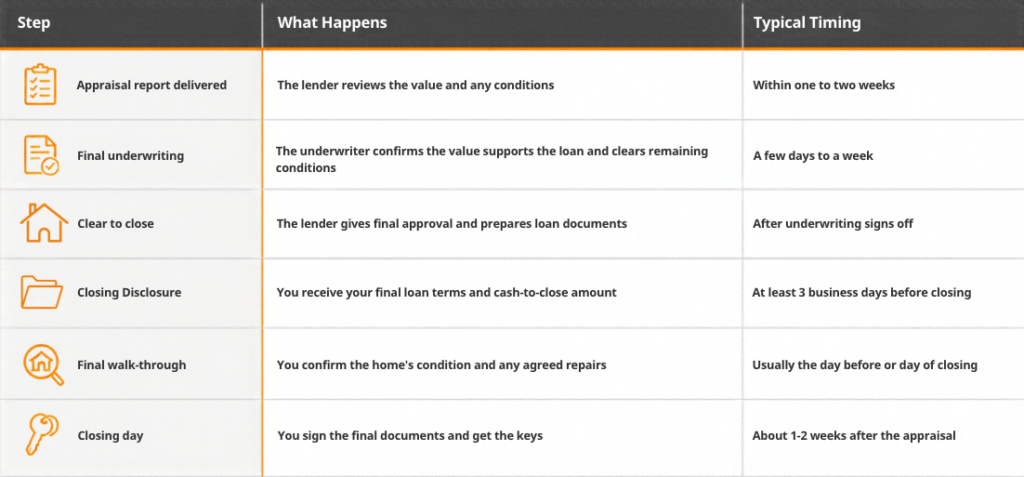
The Steps Between Appraisal and Closing Day
Final Underwriting and Loan Approval
The appraisal is one of the last big pieces the underwriter needs. Once it hits their desk, they’ll double-check that the home’s value backs up your loan and do one final pass through your financial file.
During this window, don’t be surprised if your lender asks for a recent pay stub or bank statement. Checking off those requests quickly will help keep your closing date on track.

A word of advice while you wait: Hold off on opening new credit cards, buying a new vehicle, applying for loans, or making other major purchases until after you sign the final papers. That sectional you’ve been eyeing will still be there after closing.
Clear to Close
Once underwriting approves everything, your lender issues a ‘clear to close.’ That’s the green light to confirm your closing appointment and finalize your loan documents.
Title Work in Iowa
Rather than relying on traditional private title insurance, buyers in Iowa use our state’s abstract-attorney system. An abstractor pulls together the property’s complete written history, a local attorney reviews every detail to write a title opinion, and Iowa Title Guaranty—a unique, state-backed program—issues your final title protection.
Title work happens on its own timeline, separate from the appraisal. It’s scheduled around your closing date, so depending on when you’re set to close, it may be finished before your appraisal comes back or wrap up closer to closing day.
Homeowners Insurance and Final Numbers
Your lender will need proof of home insurance before they can issue final approval, so if you haven’t shopped for a policy yet, this is a great time to cross that off your list.
If you’re comparing options, we have a guide that covers how to shop for homeowners insurance in Iowa.
At least three business days before closing, you’ll receive your Closing Disclosure. This document lays out all your final loan numbers, including the exact amount of cash you’ll need for closing day. Take a few minutes to compare it to the original Loan Estimate you received early on, and don’t hesitate to ask your lender about any figures that have changed.
Final Walk-Through
Shortly before closing, you’ll walk through the home with your agent to make sure it’s in the condition you agreed to and the seller has completed any negotiated repairs.
To see the whole process from start to finish, check out our timeline for buying a home in the Iowa City-Cedar Rapids Corridor.
What Happens if the Appraisal Comes in Low?
A low appraisal means the report valued the home below your agreed purchase price. Lenders base your mortgage on whichever number is lower, so you’ll need to settle that price gap before you can move forward to closing.
Low appraisals usually happen when local market prices are moving faster than recent sales data can track, or when there aren’t many direct comparisons nearby. We see that second scenario quite often across the Corridor, especially with rural properties and acreages. Try finding three recent sales of a 10-acre property with a pole barn and trout pond outside of Solon—these unique cases make an appraiser’s job harder.

To put it all in perspective: If you agreed to pay $375,000 for a home and the appraisal comes back at $350,000, you’re looking at a $25,000 difference.
Here are a few ways local buyers handle the gap.
Renegotiate with the Seller
Your agent can send the appraisal to the seller’s agent and ask to bring the purchase price down to match the report. Sellers are often willing to negotiate, knowing a future buyer’s lender will likely hit the same roadblock.
Both sides often meet somewhere in the middle—the seller drops the price partway, and you cover the rest out of pocket.
Cover the Appraisal Gap
If you’re set on the home and have the extra funds available, you can bring cash to the closing table to bridge the gap alongside your down payment. Some buyers also include an appraisal gap clause in their offer, agreeing up front to cover up to a certain amount if the report comes in low.

An appraisal gap clause can make your offer stand out in a competitive market, provided you stick to an amount you’re comfortable paying out of pocket.
Request a Reconsideration of Value
If you and your agent spot errors in the report—or know of more accurate local sales the appraiser missed—you can ask your lender for a Reconsideration of Value (ROV). Lenders on most conventional and FHA loans are required to explain the ROV process to borrowers.
You get one shot at an ROV per appraisal, which can include up to five strong comparable sales to support your case (and your lender can’t charge you to process it). Your agent is your best asset for pulling the comps that make the strongest case.
Get a Second Appraisal
Depending on your loan, starting fresh with a new lender or paying for a second appraisal might be an option. But that entails paying another appraisal fee out of pocket, and there’s no guarantee the new valuation will come back any higher.
If you’re using an FHA loan, this route usually isn’t an option. FHA appraisals are attached to the home’s case number for 180 days, meaning a new FHA lender will almost always end up using that exact same report.
Walk Away Using Your Appraisal Contingency
If your purchase agreement includes an appraisal contingency and you can’t reach a middle ground with the seller, you generally have the right to walk away from the deal and take your earnest money deposit with you.
Be sure to keep a close eye on the contingency deadline in your contract—that protection relies on giving formal notice on time. You won’t get refunded for the appraisal fee itself, but your main deposit stays safe.
What if the Appraisal Comes in at or Above Your Price?
This is the most common scenario. With the report checked off, your loan moves into final underwriting and you stay on track for closing day.
And if the home appraises for more than your purchase price? You still pay the agreed contract price and walk in the front door with a little extra equity already in your pocket.
What Sellers Can Expect After the Appraisal
Since the buyer’s lender orders the appraisal, you’ll typically hear the results from your agent rather than seeing the full report.

If the value comes back under the contract price, expect the buyer to reach out about a price drop. Before you respond, talk the options over with your agent. You always have the right to hold firm, but if the buyer walks away, the next appraisal could easily land at that same lower number.
If the buyer is using an FHA loan, the appraisal value stays attached to your home for the next FHA buyer who comes along.
If the report meets or beats your sale price, you’re in great shape. Focus on lining up your movers and wrapping up any agreed-upon repairs in your contract.
Get to Closing Day with an Urban Acres Agent
The days after the appraisal can feel like the slowest part of buying a home, even with plenty happening behind the scenes.
Our agents have guided many Corridor buyers through this stretch, including appraisals that came in short of the offer. Your agent is here to help you explore your options and make the right call, and when closing day comes, we’ll be there to celebrate and hand over the keys.
Have questions about an appraisal or a home you’ve got your eye on? Reach out to an Urban Acres agent.
Frequently Asked Questions
Can a deal fall through after the appraisal?
Yes, though most appraisals don’t derail a sale. A low appraisal that the buyer and seller can’t resolve is one of the more common reasons. A deal can also stall if underwriting reveals a problem with the buyer’s finances or required repairs don’t get done.
Does underwriting happen after the appraisal?
Underwriting starts before the appraisal and wraps up after. The underwriter reviews your finances early on, then uses the appraisal to finish approving the loan.
How long after the appraisal does underwriting take?
Final underwriting often takes around a week once the appraisal is in, depending on the lender’s workload and whether any conditions need to be cleared.
Can I see my appraisal report?
If you’re the buyer, yes. Your lender must give you a copy as soon as it’s complete, or at least three business days before closing, whichever comes first.
If you’re the seller, no. The appraisal belongs to the buyer and their lender, so sellers won’t get the report or the final number.
Can I close before the Closing Disclosure waiting period ends?
No. You have to receive your Closing Disclosure at least three business days before closing so you have time to review it. Certain changes, such as a switch in loan product or an APR increase beyond a set limit, restart that three-day clock.