For years, the Iowa homestead tax credit has been welcome relief on annual property tax bills for local homeowners. Yet every year, new buyers miss out because they don’t know they need to submit a one-time application to claim it.
In May 2026, Iowa lawmakers replaced the homestead tax credit with a homestead exemption—and it puts more money back in your pocket.
Below, we’ll explain what changed, how to file your application, and what extra breaks are available for veterans and homeowners 65 and older.
What is the Iowa Homestead Tax Credit?

The homestead tax credit is a property tax perk designed for Iowans who own and live in their primary residence.
Under the old system, that discount was a flat number. Iowa applied the savings to the first $4,850 of your home’s taxable value, meaning the owner of a small downtown condo got the same discount as the owner of a multi-acre property.
On May 18, 2026, Governor Reynolds signed SF 2472, officially replacing the old credit with a higher-value homestead exemption. The biggest difference? Instead of chipping away at your final tax bill, an exemption reduces your home’s assessed value before taxes are calculated.
According to the Iowa Department of Revenue, this shift from a tax credit to an exemption delivers bigger overall savings. You’ll see the new exemption reflected on your tax bills starting in September 2027 and March 2028, which apply to the 2026 assessment year.
How Much is the Iowa Homestead Exemption Worth?
Your exemption equals 10% of your home’s taxable value, with a floor of $5,500 and a cap of $20,000. To keep pace with rising costs, the state will automatically adjust that $20,000 cap for inflation each year starting in 2027.
Here’s a quick look at how the old credit compares to the new exemption for three different homes:
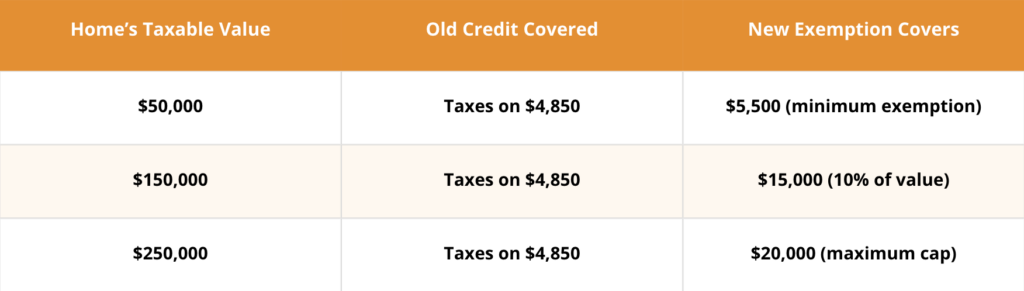
A quick note: Taxable value is almost always lower than your home’s actual market price. That’s because Iowa applies a statewide residential rollback percentage to your assessed value before calculating taxes. You can easily find both your assessed and taxable values on your local county assessor’s website.
Your exact dollar savings will depend on your neighborhood’s total levy rate, but as a rule of thumb, a $15,000 exemption means you won’t pay any local property taxes on that first $15,000 of your home’s taxable value.
Who Qualifies for the Iowa Homestead Tax Exemption?
Qualifying for the exemption is pretty straightforward, and most primary homeowners in Iowa fit the bill. Here’s a quick checklist to make sure you’re eligible:
- You own the property (or are buying it on contract).
- You live in the home as your primary residence on July 1 and for at least 6 months of the year.
- You’re an Iowa resident for income tax purposes.
A few important exceptions:
- Temporary stays: If you’re currently living in a hospital or nursing home, you still qualify as long as you aren’t renting your home to someone else.
- Military service: Homeowners away on active duty remain fully eligible.
- Property limits: Rental properties and second homes don’t qualify, and you can only claim the exemption on one primary homestead at a time.
How to Apply for the Homestead Exemption in Iowa
Ready to lock in your tax savings? The application takes just a few minutes, and once you’re approved, you don’t need to reapply unless you move.
- Step 1: Get the form. Download Form 54-028 online, or grab a paper copy from your local assessor.
- Step 2: Fill in the basics. You’ll need your move-in date, property details, and owner birth dates.
- Step 3: File with the right office by the deadline. Make sure to file or postmark your application by July 1. If you bought your home after July 1, 2026, your deadline is July 1, 2027.
Live in Iowa City? Submit your application to the Iowa City Assessor (in person, by mail/email, or online through the parcel lookup tool).
Live in Coralville or North Liberty? File with the Johnson County Assessor.
Live in Cedar Rapids? File with the Cedar Rapids Assessor.
Live in Marion or Hiawatha? File with the Linn County Assessor.
Buyer tip: Don’t be surprised when your first post-closing tax bill reflects the seller’s old exemption status. Since Iowa taxes are paid in arrears, your new exemption will show up on future bills.
Your real estate agent and closing team handle those adjustments when prorating taxes at closing, but it’s still best practice to file your homestead application as soon as you settle in.
Do I Need to Reapply for the Homestead Exemption?
The Iowa Department of Revenue confirmed that existing credits will convert to the new exemption automatically, so you don’t need to file extra paperwork. As long as you stay in your home, the exemption rolls over year after year.
You’ll only need to submit an application if you bought your home recently, or if you’ve lived there for years but never got around to filing. If you’re not sure if you signed up, look up your address on your local city or county assessor’s website. Your property page will list all active credits and exemptions currently tied to your parcel.
The Extra Exemption for Homeowners 65 and Older

If you’ll be 65 or older by January 1 of the assessment year, Iowa offers even more savings. Seniors qualify for an additional $6,500 exemption on top of the standard homestead break. Your assessor first applies the standard 10% homestead exemption, and then deducts another $6,500 from your remaining taxable value.
To get the 65+ exemption, claim it on Form 54-028 by July 1. Existing exemption holders who recently turned 65 should double-check their parcel record with the assessor to ensure it’s listed.
Lower-income homeowners 65 and older (and disabled residents) may also qualify for the Iowa Property Tax Credit. This is a separate, income-qualified program that requires Form 54-001. You’ll file this form with your County Treasurer between January 1 and June 1 each year.
Property Tax Breaks for Iowa Veterans
The 2026 property tax updates preserve Iowa’s major veteran tax breaks while adding a land limit for new claims under the Disabled Veteran Homestead Tax Credit.
This program covers the entire property tax bill for veterans with a permanent 100% service-connected disability rating, those receiving 100% compensation due to individual unemployability, and qualifying surviving spouses and dependents.
Starting with applications filed on or after July 1, 2026, the credit applies to the home and up to half an acre of land (outbuildings excluded).
If you’re looking at property with extra acreage, you’ll want to factor that land limit into your annual costs.
If you filed before July 1, 2026, you’re exempt and retain full coverage on your entire homestead property.

Photo Credit: Charles Criscuolo (Pexels)
To apply, submit Form 54-049 alongside your standard homestead application (Form 54-028) to your city or county assessor by the July 1 deadline.
Military Service Tax Exemption
Honorably discharged veterans who served during eligible periods can claim a Military Service Exemption worth $4,000 of taxable value.
A few things to keep in mind:
- Stacking rules: You can’t combine this standard military exemption with the 100% Disabled Veteran Homestead Tax Credit mentioned above—it’s meant for veterans who don’t qualify for the full disability exemption.
- How to file: Record your DD-214 with your county recorder, then file the military exemption application with your assessor by the July 1 deadline. Once approved, it continues automatically every year.
File for Your Homestead Exemption
Claiming your Iowa homestead exemption is one of the easiest ways to protect your wallet as a homeowner. It takes one simple form to set up, and the savings keep rolling in every year you call your house home. If you bought a home recently, be sure to file before the July 1 cutoff so you don’t miss out.
Whether you’re eyeing a neighborhood in Iowa City, Coralville, North Liberty, or beyond, our agents are always here to help. We can pull the full tax history on any property you’re considering so you know the true cost of homeownership—including parcel tax histories, rollback impacts, and eligible exemptions—before you write an offer.
Reach out to an Urban Acres agent today—we’d love to help you find your next home!