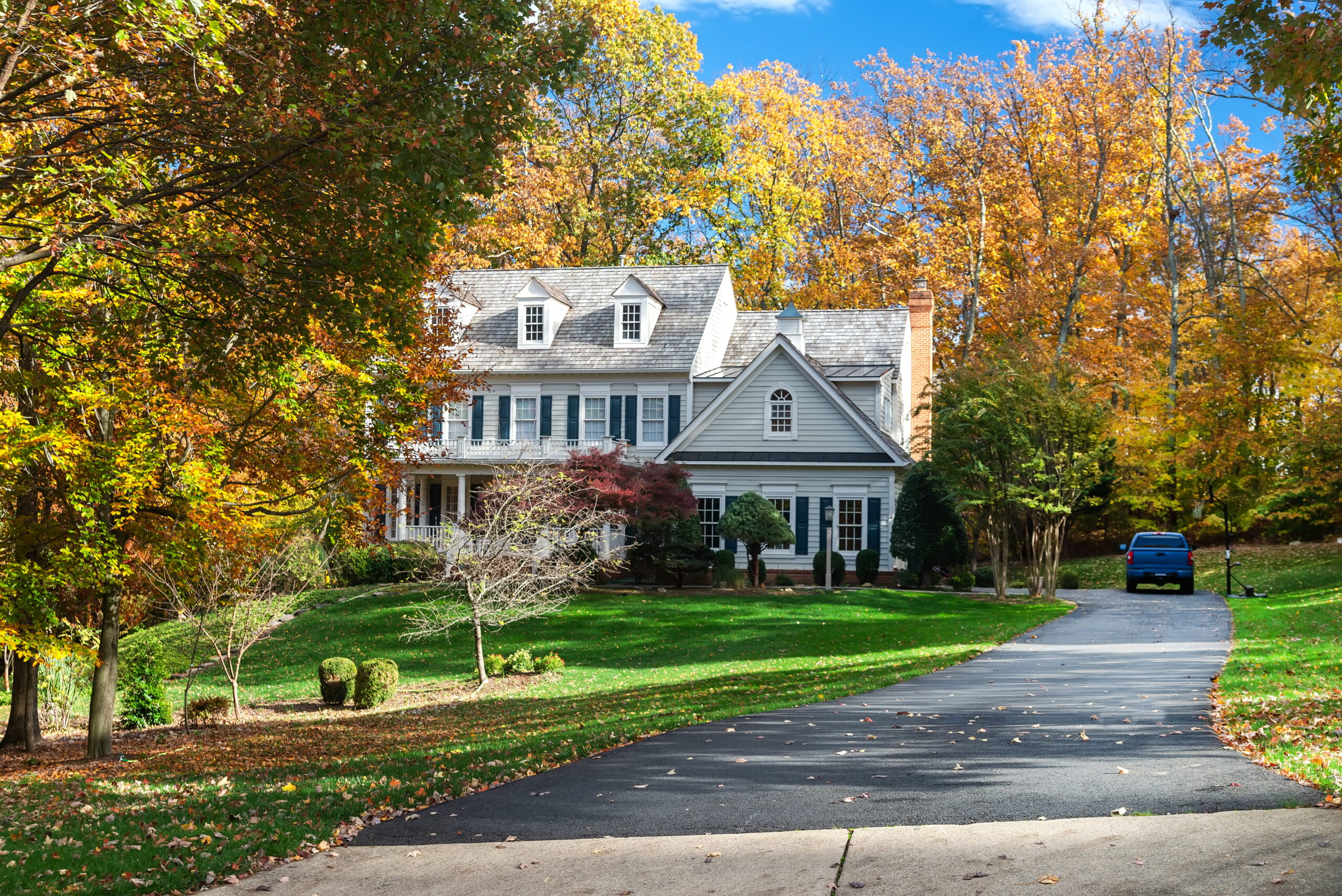
Once the kids are out of the house, many empty nesters in the Iowa City-Cedar Rapids Corridor start thinking about downsizing. The house that comfortably fit your family of five can start to feel like more than you need. Even if you don’t have kids, trading endless yard work and daily stairs for lower-maintenance living sounds better and better as you get older.
Below, we look at the four home types local downsizers choose most often and the financial details you’ll want to consider before downsizing your home. We also asked our agents to weigh in on what they’re seeing and hearing from local clients who’ve been through the process.
Signs It Might Be Time to Downsize
When most people decide to downsize, it’s often for one of these everyday realities:
- You’d rather have everything on one main floor instead of carrying laundry up and down stairs.
- You’re heating, cooling, and cleaning spaces you rarely use.
- Mowing the lawn and clearing snow have become your least favorite chores.
- You want to travel more without worrying about what’s happening at your house while you’re away.
- You’re retiring (or close to retirement) and want lower, more predictable monthly expenses.
Of all these factors, main-level living comes up in almost every conversation our agents have with homeowners.
As REALTOR® Maria McCaw points out, “Stairs become a bigger factor as time goes on. Unfortunately, we’re all getting older every day.”

Recognizing these signs doesn’t mean you have to put a for-sale-sign in your yard tomorrow. But knowing your options today helps ensure that whenever you do decide to make a move, it feels easy and intentional.
Your Main Options for Downsizing Your Home in the Corridor
Most local downsizers end up in one of four styles of homes.
“It really comes down to how you want to live,” says REALTOR® Cathy Pugh. “Some clients are ready for a full-service retirement community, while others prefer a low-maintenance condo or a smaller single-family home with everyone on one level.”
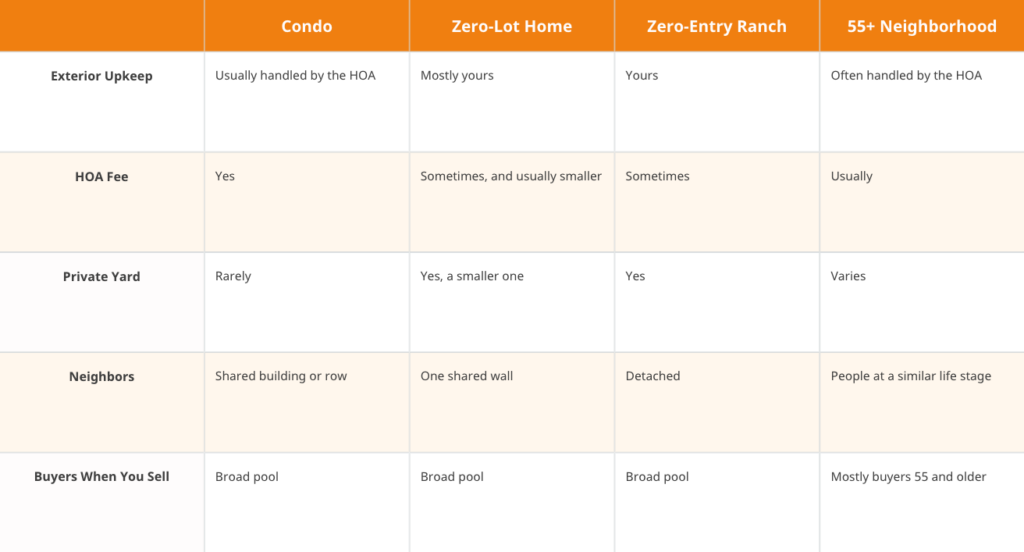
Let’s take a closer look at how these four home styles compare, and what to keep in mind for each option.
Condos
Condos are the go-to for buyers who are tired of mowing lawns and shoveling driveways. A monthly HOA fee typically covers exterior upkeep, from snow removal to roof repairs, giving you back your weekends. The tradeoff is that fee, so be sure to ask what it covers and how much is in the reserve fund for big repairs before you make an offer.
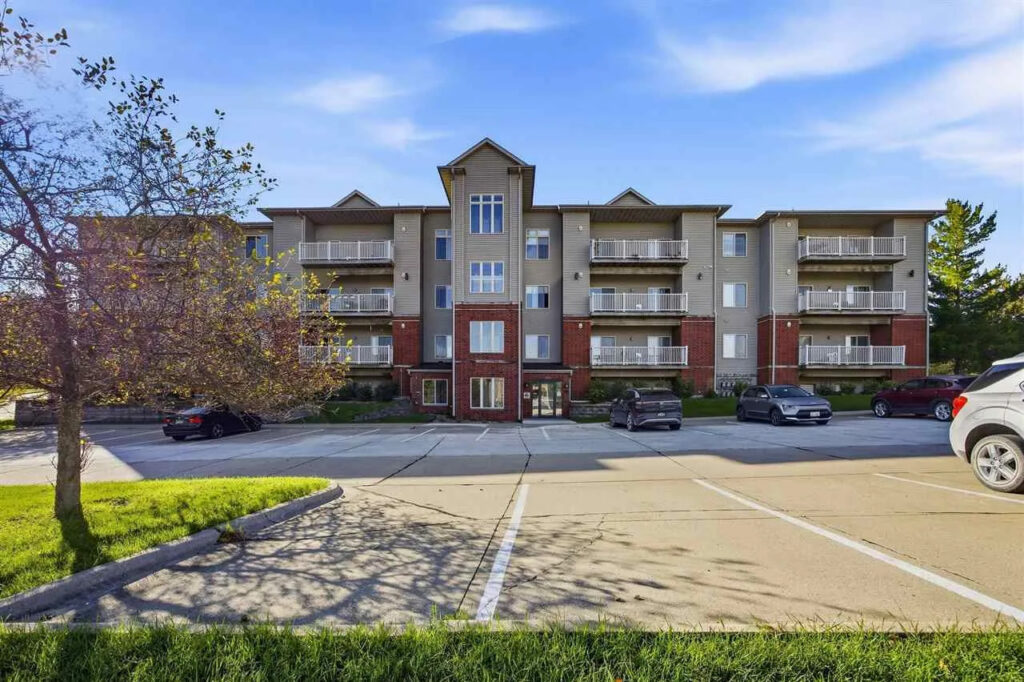
Hickory Grove Condominiums in Iowa City
Main-level, ranch-style condos with private entrances are especially popular with downsizers. If you’re scouting options around the Corridor, check out these in-demand areas.
- East Iowa City: Established spots like the Wellington and Notting Hill neighborhoods and smaller condo developments around Hanover Court and Rochester Hills.
- West Iowa City: Builders continue to put up quality, low-maintenance developments along the west side.
- North Liberty: Expanding rapidly with great single-story options, particularly in areas like Broadmoor Estates and surrounding subdivisions.
- Coralville: The condos at Brown Deer Golf Club are popular for their location and convenience.
Zero-Lot Homes
Zero-lot homes are attached pairs—you own your side and the land underneath it, sharing one center wall with a neighbor. For anyone moving out of a larger house, it’s often a much smoother stepping stone than jumping straight into a condo.
“Some couples are used to their sprawling ranches and two-stories with huge yards, so the move to a condo can feel abrupt,” says REALTOR® Mollie Kilburg. “A zero-lot gives you just one neighbor, a smaller yard to tend, and a much smaller price tag than a single-family home, without the big monthly HOA fees of a condo.”

Zero-lot home in Forevergreen Estates in North Liberty
Zero-lot homes are also fairly easy to find locally. REALTOR® Angie Eichhorst adds that these layouts are standard across newer Corridor developments—especially in North Liberty—where many are built with zero-entry designs
Zero-Entry Ranch Homes
A zero-entry home has no steps between the outside and the main living area. Pair that with a single-story layout, and everything you need day to day is on one level.
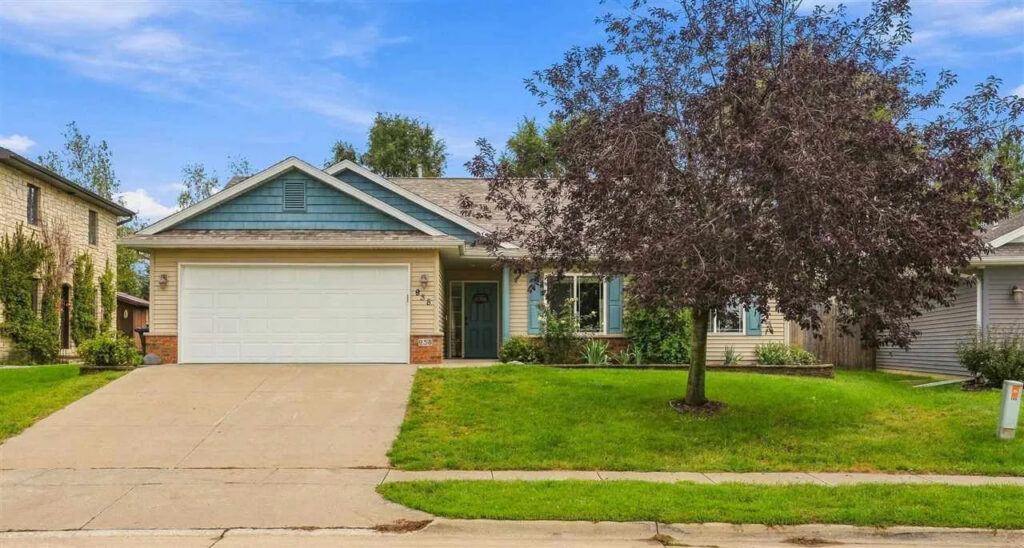
Zero-entry ranch home in Sandhill Estates in Iowa City
A few key features to look for:
- A curbless, step-free walk-in shower
- Doorways and hallways with a little extra width
- Main-floor laundry right off the primary suite or hallway
- Lever door handles instead of traditional knobs
While you’ll find zero-entry homes across the Corridor, they can still take some patience to track down.
REALTOR® Tricia Van Roekel notes, “I wish builders did more zero-entry designs and wider doorways to make homes more accessible.”
55+ and Retirement Communities

Photo Credit: Oaknoll
These communities are built specifically for older adults. Federal fair housing rules state that a 55+ community must have at least one resident aged 55 or older in at least 80% of its occupied homes. In our area, options fall into three main buckets:
- Maintenance-free 55+ neighborhoods: You own your home, but the HOA handles the physical labor, including mowing and shoveling. Neighborhoods like North Bend Villas in North Liberty offer zero-entry floor plans.
- Housing cooperatives: Instead of buying a specific piece of real estate, you buy a membership share in the co-op and pay a monthly fee for upkeep. Vintage Cooperative of Iowa City has established communities in Iowa City and Coralville.
- Full-service retirement communities: You live independently with on-site amenities like dining, plus access to assisted living later if needed. Agents frequently point clients toward The Summit of Coralville or Oaknoll in Iowa City (where the age threshold is 62).
If a full-service community is on your radar, don’t wait until you’re ready to move to look into it.
“Try to plan years in advance if going to a place like Oaknoll,” says Angie Eichhorst. “Some of these retirement villages have long wait times.”
Getting on the list early allows you to move on your own terms.
How the Options Compare
We created this side-by-side visual to help you weigh your options:
Money Questions to Address Early
A smaller home doesn’t always mean a smaller monthly bill. If you’re moving to a newer condo, monthly HOA dues can cancel out what you’d save on home maintenance. That can feel a little jarring if you’re leaving behind a house with a paid-off mortgage.
REALTOR® Andrea Hicks says many of her clients start thinking about downsizing when they retire so they have more control over their monthly expenses. “They’re worried about their fixed income and want their expenses to decrease.”
Capital Gains on Your Home Sale
If you’ve lived in your home for a long time, you’ve likely built up significant equity. The good news is that tax rules give long-term homeowners a generous cushion. Federal law lets you exclude up to $250,000 of profit from capital gains tax—or up to $500,000 for married couples filing jointly—as long as the home was your primary residence for at least two of the last five years.
A tax advisor can help you estimate what you’ll walk away with after the sale.
Iowa’s 65+ Property Tax Exemption
If you’re 65 or older, Iowa lets you claim an extra $6,500 senior homestead exemption on top of the standard homestead tax relief. Neither break transfers automatically when you buy a new house, so you’ll need to file a new application with the county assessor by July 1 after you move in.
How to Downsize Your Belongings
For most people, sifting through decades of memories is far harder than the move itself. When you’re ready to start paring down, a few practical steps make the process much easier:
- Start where emotions are low. Begin in neutral spaces like the garage, utility closet, or spare room. Leave old photo boxes and sentimental keepsakes for the very end.
- Set clear boundaries for family heirlooms. Offer items to your kids or relatives early, but give them a deadline to claim and pick up what they actually want.
- Measure before you move. Use floor plans or a tape measure to confirm your current furniture will fit comfortably in your new space.
Above all, give yourself more runway than you think you need. Tricia Van Roekel says, “Start clearing out your belongings now in preparation for a smaller space. That will help it feel less overwhelming.”

And remember: letting go of items doesn’t mean sending them to a landfill. Local Corridor donation spots, resale shops, and consignment centers give furniture and household goods a great second life with a new family.
Take It at Your Own Pace
Moving is as much an emotional transition as a logistical one, and there’s no need to rush it.
“Downsizing can be a daunting prospect, but we have tons of resources to assist with the process,” says Cathy Pugh. “Any move can spark some tough emotions, and it’s great if you can surround yourself with the support you need to lighten the load.”
We’re here to guide you through the process whenever you’re ready. If you want to talk through your options for next spring or next year, reach out to an Urban Acres agent today.
Ready to start shopping the market? Check out the single-story homes and condos currently available across the Corridor.